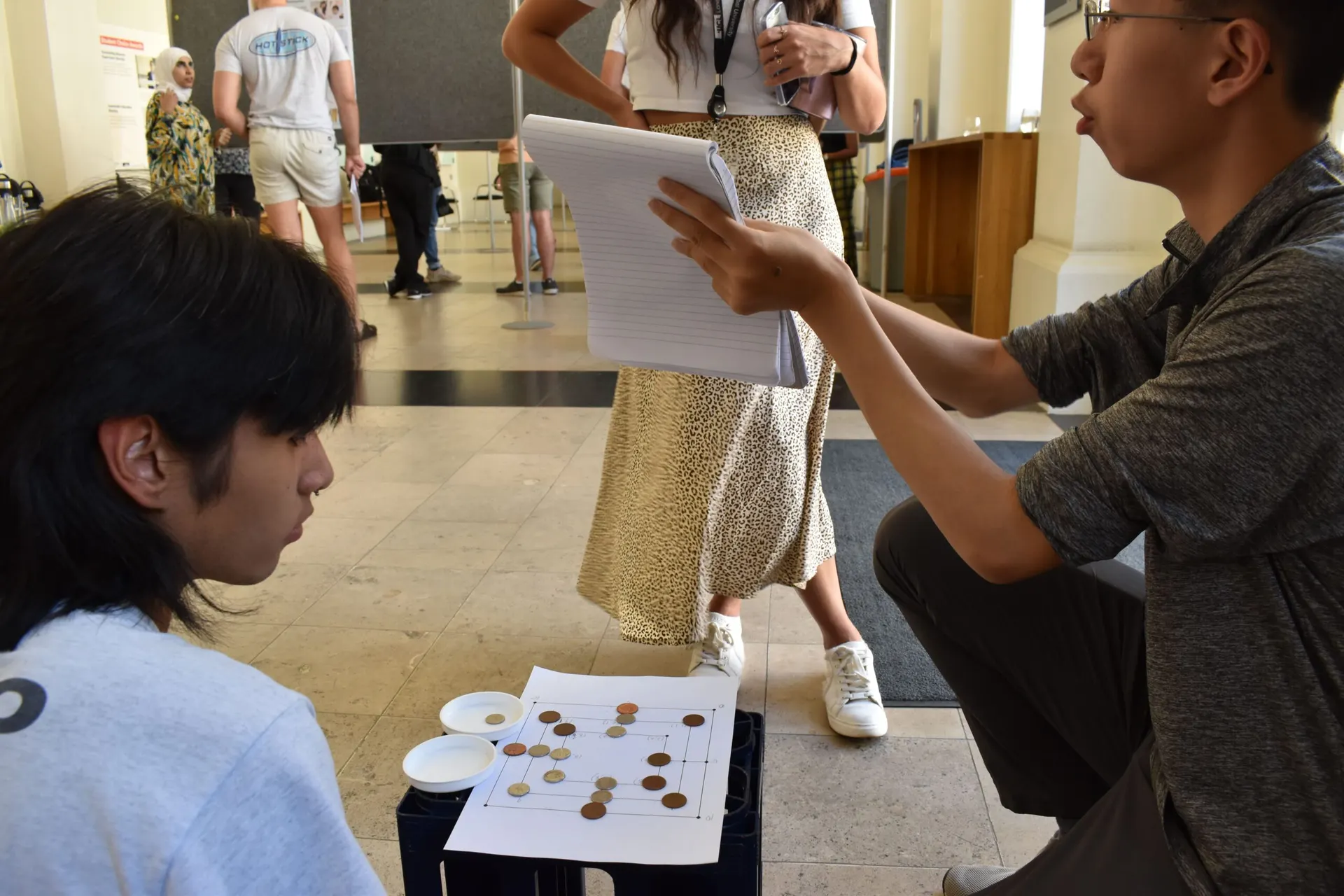
We closed applications for the 2025 summer school at five o’clock on a Friday afternoon in July, and then somebody counted them. Three hundred and fifteen.
We had thirty places.
For a small charity, a number like that arrives with two feelings attached at once, and they do not sit comfortably together. The first is that the programme is working — that eight years of turning up, of building relationships with social workers and college tutors, of asking UCL for lab space and asking researchers for their August, has produced something young people actively want. The second is the arithmetic. Two hundred and eighty-five young people filled in two forms, arranged a summer around a programme they had never attended, and were told no.
This article is about that number: what the applications actually contained, why demand has risen the way it has, what genuinely limits our capacity, what we decided to do about it, and what we decided not to do. We have published it because a ratio like ten-to-one is either the beginning of an honest conversation about scale, or it is a boast — and we would rather it were the first.
- Applications received for the 2025 summer school
- 315Applications received for the 2025 summer schoolBoth forms completed, before the July deadline
- Places available
- 30Places availableThe number the fortnight, the space and the volunteers support
- Young people we could not take
- 285Young people we could not takeThe number this article is really about
How demand grew
The ratio did not arrive suddenly. It compounded.
Applications to the free summer school
Thirty places have been available in each of these years
Show the data as a table
| Category | Value |
|---|---|
| 2022 | 60 applications |
| 2023 | 110 applications |
| 2024 | 180 applications |
| 2025 | 315 applications |
We publish those earlier years with a caveat attached, and we would rather publish them with the caveat than not at all. Our record-keeping in 2022 and 2023 was a shared spreadsheet maintained by volunteers between their own deadlines; it is good enough to show a shape and not good enough to quote to three significant figures. The 2025 number is exact, because by then we had a process.
What the shape shows is a roughly fivefold rise in four years against a completely flat supply of places. Every year we have grown the number of young people who know we exist, and every year we have offered the same thirty places.
What the applications contained
An application to us is two forms: one completed by the student, one by a parent, guardian or social worker. Together they tell us more about the state of refugee education in London than any statistic we could look up.
Age
The overwhelming majority were sixteen and seventeen — the exact age band we describe in The GCSE vacuum, where compulsory schooling has ended and every remaining route is gated on qualifications the applicant was not in the country to earn.
That concentration is not an accident of our marketing. It is where the system stops holding people.
Prior schooling
A large share of applicants had no UK qualifications at all. Many had substantial schooling from home — in several cases considerably more advanced in mathematics than the UK curriculum at the same age — and no way to evidence it.
The single most common free-text answer to “what do you find hardest?” was some version of: I understand the science, but I cannot write the answer in English.
Where they were enrolled
Almost all were enrolled somewhere, and the modal placement was an ESOL course at a further education college. As we set out in our practical guide, that is usually the correct and only available placement, and it is also the place where a year of genuine progress can end in a qualification nobody gates on.
How they found us
How applicants heard about the programme
Approximate referral routes, from the 2025 application forms
- Social worker or personal adviser35%
- College or school tutor25%
- Refugee support organisation20%
- Friend or previous participant15%
- Found us directly online5%
Show the data as a table
| Category | Value |
|---|---|
| Social worker or personal adviser | 35% |
| College or school tutor | 25% |
| Refugee support organisation | 20% |
| Friend or previous participant | 15% |
| Found us directly online | 5% |
Five per cent found us unaided. Ninety-five per cent were told by an adult.
That single fact governs everything about how a programme like ours grows, and it is the reason we now write guides for professionals rather than campaigns for students. A sentence in a tutorial reaches more of the right young people than any advertising we could buy — and it explains, too, why the demand curve above rose the way it did. We did not get better at marketing. We got better known among social workers.
Where they came from
The countries of origin in the 2025 round tracked displacement patterns rather than anything about us. Across the programme’s history we have worked with students from 23 countries; the largest groups have consistently been Eritrea, Afghanistan, Sudan, Ukraine and Iran.
Summer school participants by country of origin, since 2018
The largest groups, of 23 countries represented
- Eritrea21 students
- Afghanistan18 students
- Sudan17 students
- Ukraine14 students
- Iran11 students
- Syria5 students
- Vietnam4 students
- Saudi Arabia4 students
Show the data as a table
| Category | Value |
|---|---|
| Eritrea | 21 students |
| Afghanistan | 18 students |
| Sudan | 17 students |
| Ukraine | 14 students |
| Iran | 11 students |
| Syria | 5 students |
| Vietnam | 4 students |
| Saudi Arabia | 4 students |
Why demand is rising
We can see our own numbers clearly. The causes behind them are, honestly, harder to isolate, and we would rather set out what we think is happening than assert it.
More young people in the position. Global displacement has continued to rise, and the UK’s share of arrivals includes significant numbers of unaccompanied and separated young people in exactly the age band our programme serves.
Fewer free alternatives. Adult and community education budgets have been under sustained pressure for years, and access provision that is genuinely free — including travel and food — is scarce. Programmes that ask a young person to fund their own commute are not free in any sense that matters to an applicant on asylum support.
We became better known. The referral chart above is the mechanism. Each year a few more social workers and college tutors know we exist, and each of them holds several young people who fit.
Word of mouth. Fifteen per cent of applicants heard about us from a friend or a previous participant. That share has grown, and it is the most encouraging line in the data — it means the programme is well enough regarded that alumni recommend it.
We are wary of over-claiming on the first two points. We can measure our own applications; we cannot measure the counterfactual. What we can say is that a fivefold rise in four years is not explained by our marketing budget, because we do not have one.
What actually limits us to thirty
This is the question we are asked most, usually in the form “why not just take more?” It is a fair question and the answer has four parts, only one of which is money.
| Constraint | What it is | How hard it binds | Can money solve it? |
|---|---|---|---|
| Teaching volunteers | English teachers, workshop leads and demonstrators, giving their August | Hardest | No — they are given, not bought |
| Laboratory space | Real teaching labs in a working university department, for eight days | Hard | Only partly; it depends on a partner |
| Coordination and safeguarding | Applications, consent, matching, day-to-day running, a named point of contact | Hard | Partly — at some size this needs a paid role |
| Cash per student | Travel across TfL Zones 1–6, lunch for eight days, materials | Moderate | Yes — this is the linear part |
What binds hardest when we try to grow
Our own assessment, scored out of 5 for how tightly each constraint holds
- Teaching volunteers available in August5 / 5
Cannot be bought; recruitment runs a year ahead
- Laboratory and teaching space4 / 5
Depends on a partner institution, not on our budget
- Coordination and safeguarding capacity4 / 5
The point at which volunteer-run starts to strain
- Cash per additional student2 / 5
Travel, food and materials — real, but linear and solvable
Show the data as a table
| Category | Value |
|---|---|
| Teaching volunteers available in August | 5 / 5 |
| Laboratory and teaching space | 4 / 5 |
| Coordination and safeguarding capacity | 4 / 5 |
| Cash per additional student | 2 / 5 |
That last line is worth dwelling on, because it runs against the grain of most charity writing. If someone handed us a large cheque tomorrow, we could not double the programme this August. We would need roughly twice the volunteers, twice the lab space and a coordination layer that a volunteer team cannot carry alongside their own PhDs.
What money does do is remove the constraint that selects the wrong cohort. As we set out in Where the money goes, travel and food dominate our cash budget, and covering them completely is what keeps the programme genuinely open to the young people it exists for.
The part we like least: selection
Two hundred and eighty-five rejections is not an abstraction. It is a folder of forms, each one completed by a young person who was told this might help.
We are not going to pretend we have solved the ethics of that. What we can do is be transparent about how we choose.
We prioritise fit over attainment. We are not looking for the strongest applicants; we are looking for the ones for whom this specific fortnight would make the most difference. A student with strong grades and a supportive school has other options. A student in the ESOL loop, with an interest in science and nobody to talk to about it, does not.
We check that the programme is right for them. English is taught by level, so a wide range works — but a student with no English at all would find the fortnight hard, and we would rather point them to language provision first than set them up to struggle.
We look at the consent form. Not as a formality: it tells us whether there is a responsible adult who knows about the programme and can support eight days of travel across a fortnight in August. Where that support is missing, the risk of a young person dropping out mid-programme is high, and a half-attended fortnight helps nobody.
We keep a reserve list, and we use it. Places come free. In 2025 several did.
Incomplete applications are the largest single loss. Every year a number of applications arrive with the student form completed and the guardian consent form missing. We chase where we can, but at 315 applications and a volunteer team, we cannot chase all of them. If you are the responsible adult for an applicant, that second form is the most useful thing you will do for them this July.
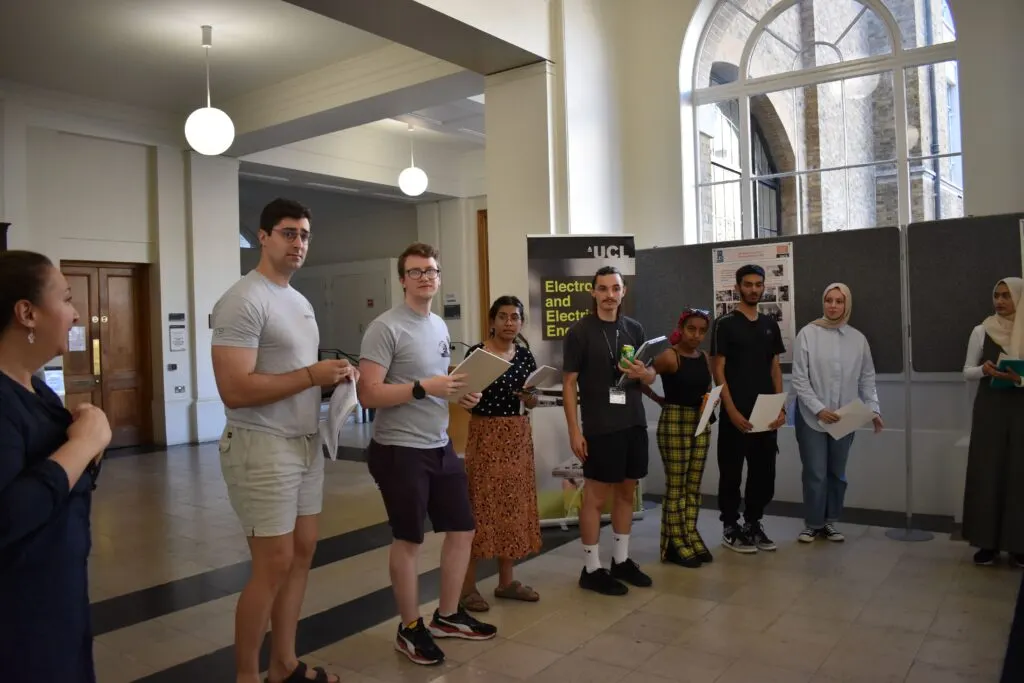
What we did about it
Four things, in the order we did them.
We ran a reserve list properly. Previously informal, now a ranked list contacted in order as places free up. It converted several rejections into attendances at no additional cost.
We wrote things down. Much of this website — the practical guide for professionals, the detailed programme description, the account of what mentoring involves — exists because 315 applications made it obvious that the information itself is scarce. If we can only take thirty, the other 285 should at least leave knowing what a foundation year is and that sanctuary scholarships exist.
We pushed harder on mentoring. The online mentoring scheme is our cheapest programme per student and our least space-constrained: it runs online, from October to March, and its limiting factor is volunteers rather than laboratories. For a young person who did not get a summer school place, it is the more useful of the two anyway, because it lasts six months rather than two weeks.
We started asking for money differently. Not because money is our binding constraint — see above — but because a broader base of regular donors is what would let us commit to a larger cohort in the spring, before we know what the summer will raise.
What we decided not to do
Three tempting responses that we rejected, and why.
Charge, or ask for a contribution. A programme that asks for £5 a day towards travel would be able to take more students and would take a different set of students. The ones excluded would be precisely the ones the programme exists for. This is not close.
Cut travel coverage to part-fund more places. A variant of the same mistake. Partial travel coverage converts a fixed barrier into a smaller fixed barrier and adds uncertainty, and uncertainty is what stops a young person in the tightest circumstances from committing their August.
Take fifty students with the same volunteers. The fortnight works because groups are small, English is set by level, and every afternoon group has a demonstrator. Diluting that would produce a larger programme that does the thing we know works less well. We would rather turn away 285 from something that works than 265 from something that half works.
What it would take to double
We have costed this roughly, because people ask. Sixty places, in one August, would need:
| Requirement | Why | Feasible? |
|---|---|---|
| Roughly double the teaching volunteers | Small groups are the mechanism; more students means more groups, not bigger ones | Hardest — this is a year-round recruitment problem |
| A second set of teaching labs, or a second fortnight | Eight days of laboratory access for twice the cohort | Depends entirely on our partner institution |
| A coordination role with real hours | Applications, consent, matching, safeguarding and daily running, at twice the scale | This is where a paid post becomes necessary |
| Double the cash per student | Travel across Zones 1–6, lunch, materials | The straightforward part |
| Governance headroom | More students, more volunteers, more risk to oversee | Our four trustees would need support |
Reading that table honestly, doubling the summer school is a two-to-three year project, not a next-August project, and it involves crossing the line from an entirely volunteer-run charity into one with at least one paid coordinator. We are not there yet. When we get closer, we will say so on this website before we do it.
What happens to the 285
Not nothing, but far less than we would like.
Everyone who applies and is not offered a place is told, and told clearly rather than left to infer it from silence. Where we can, we point people towards the things that exist: our own mentoring scheme, which has different constraints; local refugee support organisations; and the routes we describe in From 1% to 15% — foundation years, sanctuary scholarships, Access to HE.
What we do not do — and this is a genuine gap — is follow up. We do not know how many of the 285 found something else, and we do not have the capacity to find out. It is on the short list of things we would fund first with an unrestricted grant.
If you run a programme like ours
We publish our application data partly because we found almost none of it when we were starting, and a ratio is a useful planning number for anyone building access provision. Four things we would pass on.
Model demand from referrals, not from reach. Our applications track the number of professionals who know us, almost linearly. If you want to forecast next year’s applications, count the social workers and college tutors you spoke to this year — not your website traffic.
Decide your selection criteria before you need them. Choosing thirty from three hundred at eleven o’clock at night in July, without agreed criteria, is how a programme quietly drifts towards taking the most polished applicants rather than the ones it exists for. Write the criteria down in the spring.
Run a reserve list from day one. Places free up — a change of accommodation, a job, a family situation. An informal reserve list wastes them; a ranked one fills them at no extra cost.
Tell people no, clearly and early. Silence is worse than a rejection, and it is worse specifically for young people who have already spent a lot of time waiting on decisions from institutions. A short, definite email in the week after the deadline is the minimum.
The uncomfortable corollary of all four is that a well-run programme generates more visible unmet demand than a badly run one, because more people find it and more people complete an application. That is not a reason to run it badly.
What the number does not tell us
Three cautions about our own headline figure, because a ratio is easy to over-read.
It is a measure of unmet demand for our programme, not of total unmet need. Some applicants will have applied to several things and been placed elsewhere. Some had reasonable alternatives. Our 315 is a lower bound on a bigger number and an upper bound on nothing.
It says nothing about outcomes. As we set out in our description of the programme, we count applications, attendance, countries and volunteer hours exactly, and we do not measure progression, because we have never had the resources to follow our alumni properly. A programme can be enormously oversubscribed and still not be the thing that changes a life. We think ours helps; we cannot prove the counterfactual.
It is one year, in one city. London is not the UK, and 2025 is not a trend. The four-year shape above is more informative than the single ratio, and even that comes with the record-keeping caveat we set out at the top.
Common questions
Does a rejection mean the application was weak? No. With ten applicants per place, most of the young people we turn away would have done well. Selection is about fit for this particular fortnight, not a judgement about ability.
Can someone apply again next year? Yes, and several of our participants applied in a second cycle. It is not held against an application.
Is the mentoring scheme also oversubscribed? Less severely, and its constraint is different: it is limited by how many volunteer mentors we can recruit and support, not by space or by August. That is why we push it hardest when we are asking for help.
Would you take more students if a donor funded it? Not immediately. Money removes the cash constraint, which is the least binding of our four. Doubling would need volunteers, space and coordination capacity as well — see the table above.
Where can I check these numbers? Our own figures come from programme records, and our audited accounts are filed with the Charity Commission under registration number 1201227. Third-party context links to its primary source in the list below.
How can I help most, in one sentence? Mentor from October to March, tell a young person the programme exists before mid-July, or set up a small monthly donation so we can commit to places in the spring.
Compiled September 2025 and reviewed against our 2026 programme dates. The 2025 application figure is exact; earlier years and the referral proportions are drawn from our internal records and are indicative. Audited financial statements are filed with the Charity Commission for England and Wales under registration number 1201227.
Keep reading
- The GCSE vacuum — why the applicants cluster at sixteen and seventeen.
- Inside a free STEM summer school — what the thirty places actually consist of.
- Where the money goes — the cost of a free place, line by line.
- A practical guide to supporting a young refugee into education — for the professionals who make up 95% of our referrals.
- Apply to our programme — dates, venue and the two forms.
Sources & further reading
Every third-party figure quoted above links back to its primary source. Where a statistic is our own, it comes from our programme records.
- Summer school programme, Bridging the Future
- Apply to our programme — dates, venue and forms, Bridging the Future
- Search the register of charities — Bridging the Future, no. 1201227, Charity Commission for England and Wales
- Key statistics about asylum seekers and refugees in the UK, Refugee Council
- Research and reports on refugee education, Refugee Education UK
- Global Trends: Forced Displacement, UNHCR
- Fares and Zones, Transport for London
- Bridging the Future programme records, 2018–2025, Bridging the Future
Spotted something out of date, or have a figure we should include? Write to contact@bridgingthefuture.org and we will correct it.